The proposed program overview for the “Master’s Degree in Corporate Communication” comes to reinforce the postgraduate training offerings within the Department of Communication Sciences at the National Higher School of Journalism and Information Sciences. The academic necessity of introducing this updated specialization is driven by the demands of rapid technological and cognitive transformations, reflecting the significant theoretical and practical weight of this field across its professional and epistemological dimensions. This academic path investigates the various digital and institutional shifts imposed by recent scientific advancements on one hand, and the outcomes of total convergence that inherently fuses cutting-edge digital technologies with the multidimensional contexts of the institutional communication architecture on the other.
The theoretical tracks framed by this specialization address intellectual perspectives related to institutionalizing human communication across its diverse new media interfaces within the digital ecosystem. Furthermore, they trace the transformations altering the communication process across all its elements, components, and scholarly contexts. This is achieved by integrating and examining updated, contemporary communication theories, exploring the mechanisms and methods of digital transformation within the digital communication environment, and addressing accompanying issues such as digital identity, digital visibility, media management, and other core themes that serve as the scientific foundations underwriting this academic specialization.
Core Training Pillars
Overcoming Academic Limitations
Preparing students as viable professional entities capable of understanding the demands of the institutional workspace.
Foundational Knowledge Architecture
Empowering students in alignment with the latest advancements in scientific knowledge within the field of corporate communication.
Updating Curricula and Communication Theories
Updating the theoretical foundations of corporate communication to align with the unique dynamics of the digital ecosystem.
Mastering Digital Transformation
Defining its scopes, tracing its impacts on the field of corporate communication, and mapping this transformation onto the theoretical foundations of the discipline.
Facilitating Professional Integration
Enhancing student competencies to align with evolving operational environments and the deployment of modern communication technologies.
Contemporary Digital Issues
Examining digital identity, digital visibility, reputation management, and the ethics of corporate communication in the digital age.
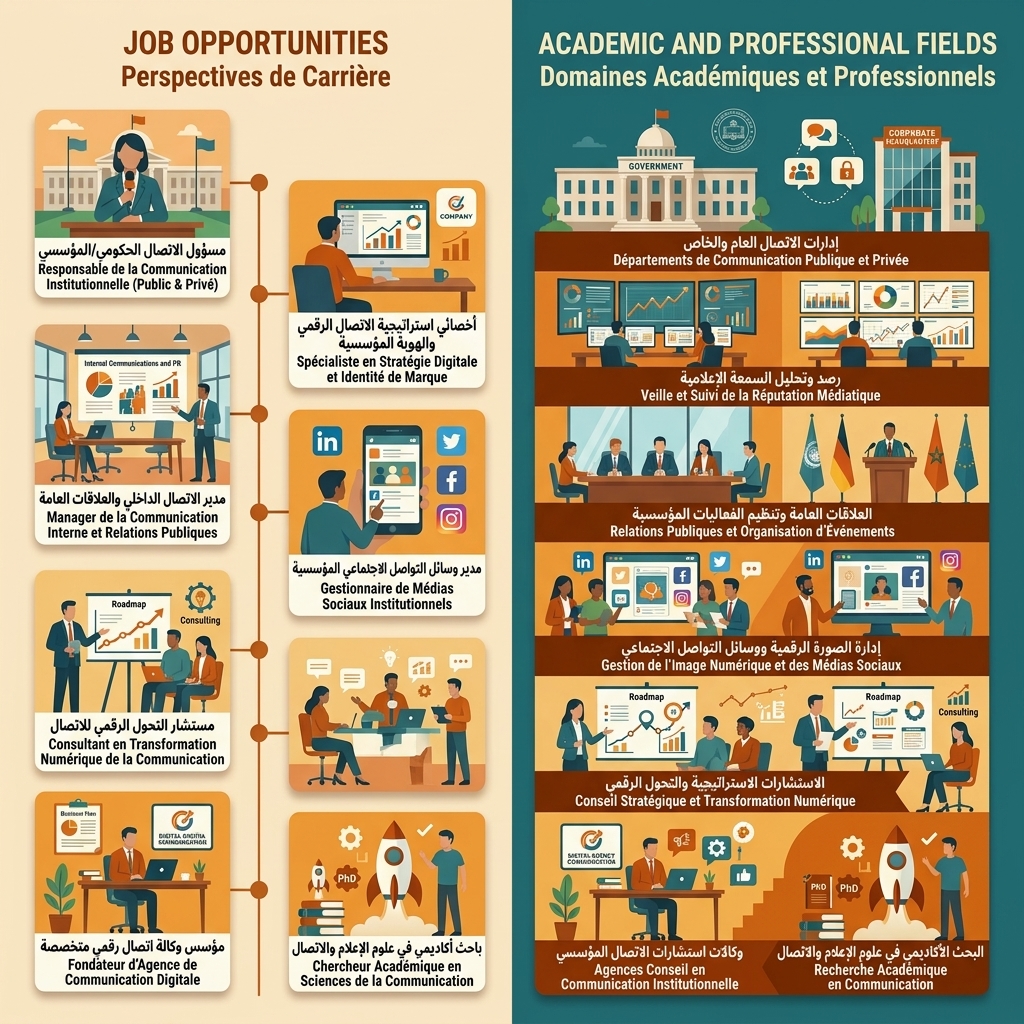
Academic and Professional Horizons
This specialization offers graduates diverse career opportunities in:
Corporate Communication Departments across public and private sectors.
Digital Reputation and Corporate Identity Management for companies, brands, and institutional bodies.
Public Relations (PR) and Internal Communication within large-scale enterprises.
Social Media Management for corporations, organizations, and commercial brands.
Strategic Consulting in digital transformation and institutional communication.
Entrepreneurial Ventures, including launching specialized boutique digital communication agencies.
Advanced Academic Research, qualifying graduates for PhD programs in Media and Communication Studies.
Admission to the Master’s program is subject to specific academic criteria, and selection is competitive, based on a comprehensive file review followed by a competitive examination.
Admission to this Master’s program is granted through a national competitive written examination. The competition is open to holders of a Bachelor’s degree (Licence) in Media and Communication Studies (all specializations). Candidates holding undergraduate degrees in other related disciplines—such as Sports Science and Physical Education, Management, Law, International Relations, and Information Technology—are also eligible to apply, subject to specific criteria defined by the Examination Committee.
Registration & Enrollment → Via the central university orientation platform or the official website of the National Higher School of Journalism and Information Sciences (ENSJSI).
Curriculum program
For detailed information on course modules, pedagogical objectives, and program structure, please download the complete curriculum syllabus.