This specialization is designed to address the radical transformations within the local and international media landscape, where the distinction between traditional media (television, radio) and digital platforms is no longer sustainable. This Master’s program aims to bridge the gap between classical theoretical training and the requirements of emerging new media. It operates within a global context defined by media convergence, where the lines between broadcasting studios and digital publishing platforms have increasingly blurred.
We are now in the “age of video,” where it has become the primary language of communication across all platforms, necessitating that journalists possess the multifaceted skills of the “Total Journalist.” Beyond updating previous curricula, this program represents a reinvention of the audiovisual journalist’s identity. It maintains an unwavering commitment to academic standards, ensuring graduates possess the critical and analytical capabilities to contribute to the advancement of scientific research in media and communication sciences.
Core Curriculum Pillars
Developing Adaptable Media Professionals
capable of producing professional content tailored simultaneously for television and radio broadcasting environments as well as social media platforms.
Mastering Digital Storytelling and Content Creation
Equipping students with the skills to construct interactive news stories utilizing multimedia elements (video, audio, data, and graphics).
Developing Critical and Analytical Thinking
Enabling students to deconstruct media discourse and analyze information disorder (Fake News) within digital environments.
Technical and Professional Empowerment
Managing the end-to-end production pipeline (One-Man Crew)—from script conceptualization and development to professional video editing, audio engineering, and quality optimization for digital publishing.
Mastering Mobile Journalism (MoJo)
Enabling students to utilize the smartphone as an all-in-one tool for news and documentary production, while mastering advanced technical accessories.
Fostering Digital Ethical Awareness
Cultivating an ethical compass within students to navigate intellectual property issues, privacy, the protection of sources, and the distinction between freedom of expression and hate speech.
Semiological and Critical Analysis
Equipping students with methodological tools to deconstruct media messages (content and discourse analysis), and understanding agenda-setting mechanisms alongside the impact of algorithms on steering public opinion.
Managing Media Startups and Media Economics
Providing students with the fundamentals of media economics, enabling them to launch their own media ventures (platforms, production studios, or fact-checking agencies) and manage them financially and strategically for the market.
Understanding Digital Audience Psychology
Studying new consumption patterns and mastering data analytics skills to understand user behavior and adapt content accordingly.
Academic and Career Prospects
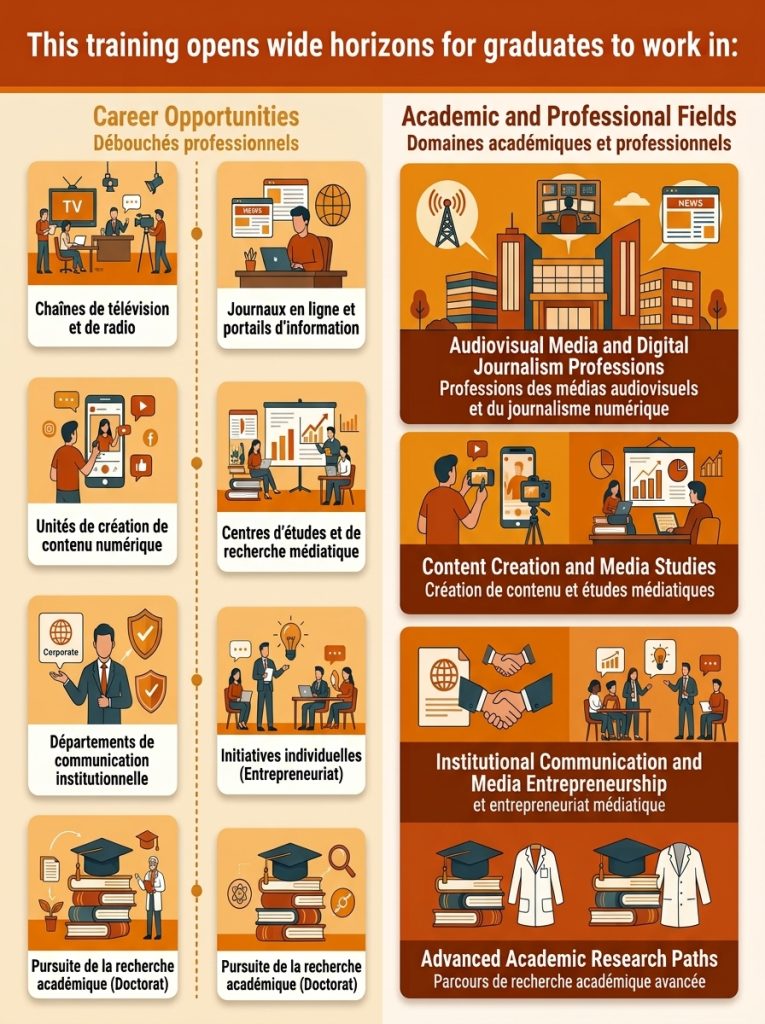
This program opens broad horizons for graduates to work in:
Television and Radio Stations (as editors, presenters, directors, or producers)
Digital Newspapers and local or international news portals
Digital Content Creation Units and professional “influencer and impact” agencies
Media Research and Studies Centers
Corporate Communication Departments and digital reputation management
Independent Ventures in launching private startups and media projects (entrepreneurhip)
Pursuing Academic Research in cutting-edge fields related to the specialization (Ph.D. track)
Admission to the Master’s program is subject to specific academic requirements, and acceptance is granted via a competitive selection process following a comprehensive review of the applicant’s dossier.
Admission to this Master’s program is granted through a national competitive entrance examination (written exam), open to holders of a Bachelor’s degree (Licence) in Media and Communication Sciences (all specializations). Participation is also extended to graduates holding degrees in other related disciplines, subject to conditions determined by the examination committee.
Registration & Enrollment ➔ Via the university orientation platform or the official website of the National Higher School of Journalism and Information Sciences.”
Curriculum Structure
“To review the course modules, pedagogical objectives, and academic structure, please download the complete curriculum program.